
VISION GUIDES SELECTION OF FREEZE OR FLIGHT DEFENSE STRATEGIES IN MICE
Gioia De Franceschi, Tipok Vivattanasarn, Aman B. Saleem*, Samuel G. Solomon*
*Co-senior author
Highlights
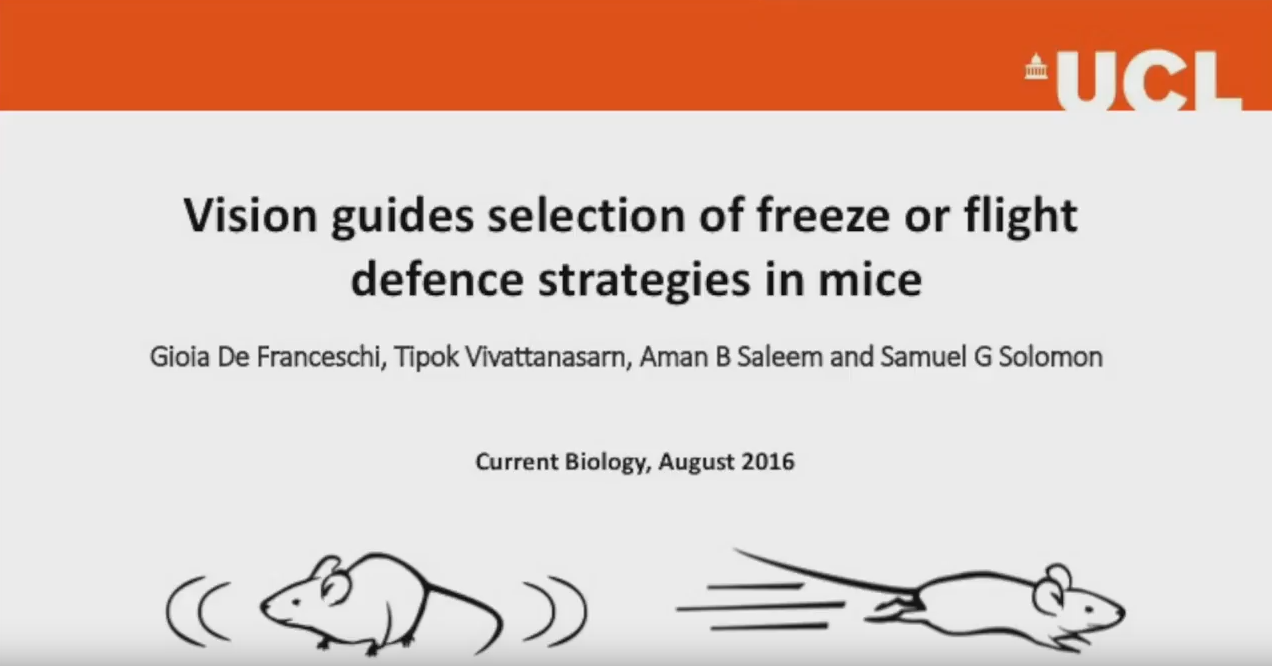
- Rodents use vision to choose how to respond to an overhead threat
- A moving disk induces freezing, while an expanding disk induces flight responses
- Opposing innate behaviors can be induced by visual stimuli

SUMMARY
In prey species such as mice, avoidance of predators is key to survival and drives instinctual behaviors like freeze or flight [ 1, 2 ]. Sensory signals guide the selection of appropriate behavior [ 3 ], and for aerial predators only vision provides useful information. Surprisingly, there is no evidence that vision can guide the selection of escape strategies. Fleeing behavior can be readily triggered by a rapidly looming overhead stimulus [ 4 ]. Freezing behavior, however, has previously been induced by real predators or their odors [ 5 ]. Here, we discover that a small moving disk, simulating the sweep of a predator cruising overhead, is sufficient to induce freezing response in mice. Looming and sweeping therefore provide visual triggers for opposing flight and freeze behaviors and provide evidence that mice innately make behavioral choices based on vision alone.